

Tour Guide Systems for Factory and Industrial Tours: What to Look For
Factory and industrial site tours present a unique set of challenges that standard tour guide systems aren't always built to handle. High ambient noise, large floor spaces, safety requirements, hearing protection obligations, and groups of varying sizes all mean that the wrong equipment can turn a well-planned visit into a frustrating experience.
If you're setting up audio communication for industrial tours, this guide covers exactly what to look for.
The main challenge: noise
Factory floors, production lines, and industrial sites are loud. Background noise from machinery, ventilation systems, and equipment can easily drown out a guide's voice — even with amplification.
A good tour guide system deals with this in two ways:
- Wireless transmission directly to the receiver — rather than relying on the guide's unamplified voice carrying across a noisy space, the audio is transmitted wirelessly and heard through each participant's earphone or headphones at a comfortable, consistent volume. Ambient noise becomes much less of a problem.
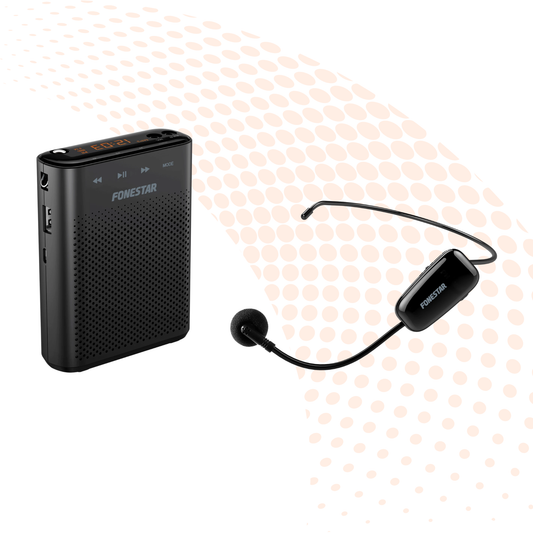
- Quality microphones — a headband or tie-clip microphone positioned close to the guide's mouth picks up speech clearly even in noisy environments, ensuring the transmitted audio is clean before it reaches your participants.
For particularly loud environments, a headband microphone is generally preferable to a tie-clip, as it stays closer to the mouth regardless of how the guide moves.
Range requirements
Industrial sites are often large. A transmitter rated for 30 metres may be perfectly adequate for a compact workshop but completely insufficient for a sprawling warehouse or a multi-floor production facility.
For most factory environments, we recommend a system with at least 100 metres of transmission range. For very large sites — distribution centres, outdoor industrial areas, or facilities spread across multiple buildings — a 150-metre system is the safer choice.
Remember that walls, metal structures, and heavy machinery can reduce effective range. When in doubt, choose a system with more range than your floor plan suggests you need.
Hearing protection: a critical consideration
Many industrial environments legally require visitors to wear hearing protection. This creates an immediate problem: standard tour guide earphones can't be worn with ear defenders.
The solution is purpose-built industrial hearing protector headphones that combine hearing protection with an integrated audio connection. These allow your participants to comply with your site's PPE requirements while still hearing the guide clearly through the system.
We stock industrial hearing protector headphones with 3.5mm connection leads, including both over-ear and neckband styles, specifically designed for this application. If your site requires hearing protection, these are an essential accessory — not an optional extra.
Induction loops for hearing aid users
Industrial tours often include a mix of visitors, some of whom may use hearing aids. Standard earphones are incompatible with many hearing aids, but an induction loop (also called a neck loop) connects to the receiver and transmits audio directly to a hearing aid via a telecoil — no earphone required.
Including induction loops in your kit ensures your tours are accessible to all participants, which is both a legal consideration under the Equality Act and simply good practice.
Channels and multi-group operation
Large industrial sites sometimes run multiple tour groups simultaneously — different departments, different languages, or back-to-back visitor groups at the same time. In these situations, channel separation is important.
Make sure your system offers enough channels to operate multiple groups without interference. A 16-channel system supports up to 4 simultaneous groups, which covers most industrial tour operations. If you regularly run more groups than that in the same space, a 42-channel system offers significantly more flexibility.
Robustness and ease of use
Visitors on an industrial tour are not there to learn how to operate audio equipment. The system needs to be simple enough that a receiver can be handed to someone at the start of a tour with minimal instruction — ideally just "put this in your ear and press this button if the volume needs adjusting."
Look for receivers with clear, simple controls, an LCD display showing battery level and channel, and a durable build quality that can withstand the realities of regular industrial use. Lightweight devices are also important — participants are already potentially wearing PPE, hard hats, and safety vests. Adding bulky audio equipment to that isn't ideal.
Charging between tours
Factory tours often run in back-to-back sessions. A charging bag that powers all devices simultaneously overnight (or during a lunch break) is essential for smooth operations. Make sure the capacity of your charging solution matches your receiver count — our 12-slot and 35-slot charging bags cover most industrial tour setups.
Recommended setup for industrial tours
Based on the above, here's what a solid industrial tour guide system typically looks like:
- 1-way system with 100m+ transmission range
- Headband microphone for the guide
- Industrial hearing protector headphones for all participants (if PPE is required on site)
- Induction loops available for participants with hearing aids
- 16-channel transmitter if running multiple simultaneous groups
- Charging bag sized for your total receiver count
Browse our industrial tour guide systems or contact us to discuss your specific site requirements — we're happy to help you put together the right kit.
Related reading: How to choose the right tour guide system for your group size · 1-way vs 2-way tour guide systems: which do you need?